What Does a COA (Certificate of Analysis) Actually Tell You? A Buyer's Guide
"A supplement brand received a COA showing 99.8% purity. Eighteen months later, they faced an FSSAI import alert. What did they miss on that document?"
If you’ve sourced raw materials or nutraceuticals, you know the routine: check specs, request a COA, and move on. A clean COA feels like approval.
But it isn’t, at least not always.
COAs are often misread not due to carelessness, but because buyers aren’t trained to interpret what they truly show or what they leave out.
This guide helps you read a COA like a scientist, not just a box-ticker. So you can make informed, audit-ready decisions.
What Is a COA, really?
A Certificate of Analysis (COA) is a lab-issued report generated by analytical laboratories or a microbiological testing laboratory, showing test results for a specific product batch and whether it meets defined specifications.
But here’s the catch: a COA is a snapshot not a guarantee. It reflects one batch, tested once, under specific conditions.
It doesn’t prove the product is consistently good—only that this batch met these standards. And its reliability depends on the lab’s credibility, methods used, and what was tested.
In regulated markets, that distinction is critical.
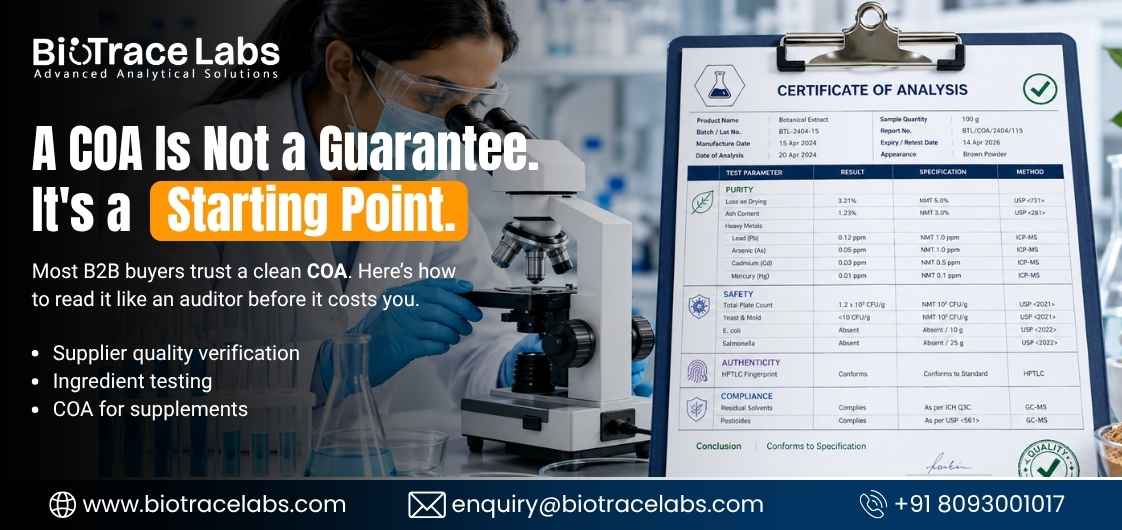
Anatomy of a COA: The Five Zones Every Buyer Should Know
Think of a COA as a document with five distinct zones. Each zone tells you something different — and each has its own failure modes.
Zone 1: The Identity Zone
This section covers basic identification: product name, batch/lot number, manufacturing date, expiry or retest date, and the quantity tested.
The batch or lot number is the single most critical element on a COA because it's the traceability anchor. If the lot number on the COA doesn't match the lot number on your purchase order, invoice, and physical shipment, you may be looking at a recycled document.
What to verify: Cross-check the lot number against your PO and shipping documents before reading anything else. If they don't align, stop there.
Zone 2: The Purity Zone
The purity zone covers heavy metals (lead, arsenic, cadmium, mercury), moisture content, ash content, and residual solvents if applicable.
These parameters matter deeply because they directly affect both safety and product performance.
What to verify: Results mean nothing without corresponding limits. Always check that the COA shows both the test result and the acceptance limit for each parameter.
Zone 3: The Safety Zone
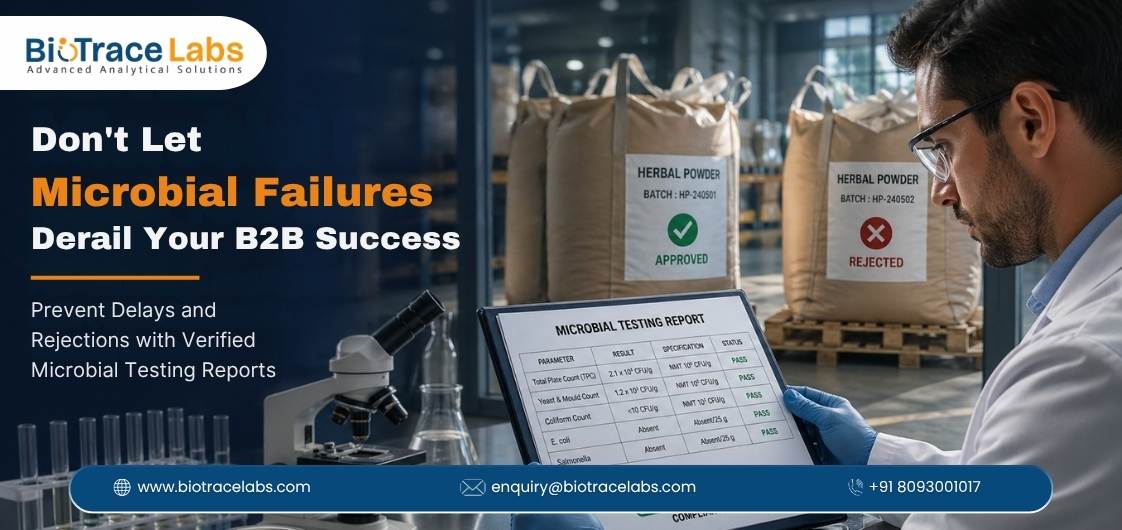
The safety zone covers microbiological testing performed by specialized microbial testing labs or a certified microbiological testing laboratory, including Total Plate Count (TPC), yeast and mold, coliforms, and critical pathogen testing for organisms like Salmonella, E. coli, Staphylococcus aureus, and Listeria.
What to verify: A COA that only reports "absent" for pathogens without specifying the detection method or sensitivity level is incomplete.
Zone 4: The Authenticity Zone
This zone is often entirely absent from supplier-issued COAs, and that absence is itself a red flag.
This is particularly critical for botanical and herbal ingredients where substitution and adulteration are prevalent. The gold standard here is HPTLC (High-Performance Thin Layer Chromatography) a fingerprinting technique that produces a visual chromatographic profile unique to the plant species, allowing direct comparison against authenticated reference standards.
What to verify: Does the COA include identity confirmation beyond just a visual or organoleptic check? If your supplier's COA says "appearance: brown powder, complies" as the identity test, that's not an identity test. That's a description.
Zone 5: The Compliance Zone
This final zone is where the professional analyst's eye goes first: the methodology section. Every result on a COA should reference the validated analytical method used to generate it. Methods like USP (United States Pharmacopeia), AOAC International, IP (Indian Pharmacopoeia), or ISO standards are internationally recognized and reproducible.
What to verify: If a COA references "tested as per in-house method" with no further detail, that method has never been independently validated.

Why Labs Issue COAs And Why It Matters Who Issues Them
Every COA has an issuer and that matters as much as the document itself. There are three main sources:
- Supplier’s Internal Lab
Most common but inherently conflicted. Testing their own product creates a tension between accuracy and commercial interest. Not necessarily wrong but not independently verified.
- Third-Party Labs (Non-Accredited)
More independent, but reliability varies. Without accreditation, there’s no guarantee of validated methods, calibrated equipment, or trained analysts.
- Accredited Independent Labs
The gold standard for regulated markets. NABL or ISO/IEC 17025 accreditation ensures validated methods, audited processes, traceable systems, and qualified personnel—making COAs audit-ready and defensible.
Bio Trace Labs operates as an independent analytical testing laboratory and microbiological testing laboratory, providing fully traceable, audit-ready COAs with end-to-end documentation from sample receipt to final report.
The 7 COA Red Flags Buyers Ignore Until It's Too Late
These are the signals most buyers overlook during routine procurement and the ones that surface during legal inspections, customer complaints, or failed import clearances.
- Red Flag 1: No reference method cited Results without a method are unverifiable. If you can't determine how a test was performed, you can't challenge the result.
- Red Flag 2: "Complies" with no numerical data Qualitative pass/fail statements with no underlying data protect the lab, not the buyer. Always demand quantitative results.
- Red Flag 3: Lot number doesn't match your purchase documents This is the most common form of COA misrepresentation, an older clean result presented as current batch data. Always verify.
- Red Flag 4: The lab is unnamed or uncontactable Anonymous COAs are not defensible.
- Red Flag 5: Missing uncertainty of measurement- Its absence suggests methods haven't been properly validated.
- Red Flag 6: Tests don't cover your label claims If your product label claims "500mg ashwagandha extract standardized to 5% withanolides," your COA must show withanolide content verification. A COA that tests only appearance and microbiology doesn't validate your label claim.
- Red Flag 7: The COA is undated or "evergreen" Some suppliers present COAs with no expiry or retest date. Stability data has a shelf life. An undated COA is no COA at all.

What a Good COA Actually Looks Like: The BioTrace Standard
At BioTrace Labs, we support food, nutraceutical, and botanical businesses with COAs built to withstand FDA audits, retailer reviews, and global inspections—not just supplier checks.
In practice:
- Microbiological Testing: Covers TPC, yeast & mold, coliforms, E. coli, Salmonella, S. aureus, and Listeria—with FDA/USP-aligned methods and full traceability (test date, analyst, method).
- Analytical Testing: Performed in specialized analytical laboratories using chromatographic and spectroscopic methods for identity, potency, purity, and heavy metals (HPLC, ICP), with validated methods and documented data.
- HPTLC Authentication: Confirms botanical identity using fingerprinting against certified reference standards.
- Audit-Ready Documentation: End-to-end traceability—sample receipt to final report—backed by full supporting records.
COA Vocabulary — Quick Guide
- LOD: Smallest detectable amount of a substance.
- LOQ: Smallest measurable amount (higher than LOD).
- CFU: Unit for microbial count (e.g., “<100 CFU/g”).
- USP: FDA-recognized standards for testing methods.
- AOAC: Global body for validated analytical methods.
- TPC: Total microbial load; high values signal contamination.
- HPTLC: Technique for botanical identity verification.
- Uncertainty of Measurement: Confidence range of a result; must be reported by accredited labs.
- Retest Date: When a batch must be re-verified—not the same as expiry.
The Bottom Line
A COA is only as strong as the lab behind it, the methods used to generate it, and the parameters chosen to be tested. A document that looks complete can still be incomplete. A result that appears to pass can still hide a failing ingredient.
The buyers who never face supply chain failures aren't the ones who receive the cleanest-looking COAs. They're the ones who know exactly what to look for — and who insist on independent, accredited testing from labs that document everything.
If your current COA process is built on trusting supplier documentation, it's time to upgrade your standard.
BioTrace Labs provides independent, audit-ready analytical and microbiological testing for food, nutraceutical, and botanical products — structured for international regulatory review.
📰 Latest Blogs